
Fostering transparency
Ground-breaking initiatives are blooming in the sector to foster disclosure of non-financial data on the effects of economic activities on people and the planet. However...

While this increase in transparency is a positive sign in general, there is a concrete risk that it will turn into a compliance exercise that places a burden on organisations, especially with fewer resources, without necessarily generating any useful learning. Transparency should include an 'impact management’ component – that is, investors should display how decisions are made, what trade-offs are identified, how negative impacts are mitigated and how positive impacts are maximised.
Transparency and impact measurement and management (IMM) are two sides of the same coin. A robust IMM system helps an organisation be more transparent about its activities and outcomes, while a mandate for transparency prompts the organisation to strengthen its IMM practices.
The demand for transparency is now spreading, thanks to initiatives such as the EU Social Taxonomy and the Impact-Weighted Accounts Initiative (IWAI). However, current transparency efforts too often only focus on the measurement component, which risks becoming a compliance exercise with limited added value, rather than driving concrete improvements. Investors for impact stress the importance of the impact management component by showing how impact data enables better informed decision-making.
Transparency is a means to validation, but can also have added benefits for the ecosystem, as an organisation can share their learnings widely and enhance progresses in the ecosystem. Investors for impact believe in the benefits of furthering transparency to improve their own practices and knowledge – as well as the community’s.
Challenges for transparency
A key challenge is to identify what is realistic and relevant to be shared. Given their experience and knowledge, investors for impact should contribute to this process. Apart from negative and positive results, other elements to consider sharing are:
-
Methodologies used for measuring and managing impact
-
Decisions made
-
Available data
-
Trade-offs detected
-
Areas of improvement identified
Another challenge relates to the standardisation of methodologies and metrics and the possibility to compare impact performances. Luckily, a rigorous well-disclosed IMM system is already a good starting point for an organisation seeking to develop a culture of transparency towards its stakeholders.
Another barrier to transparency is commercial confidentiality. Although confidentiality is usually more linked with financial transparency, it can also affect impact disclosure. Some investors might be reticent to share impact performances due to confidentiality, but investors for impact have always shared it widely through their impact reports.
Transparency also entails showing failures and negative impacts, which sometimes can pose reputational risks for investors and investees. However, if sharing negative impacts and failures is seen as a demonstration that an organisation is capable of understanding and managing them, then dialogue and trust among peers will increase, generating learnings at sectorial level and fostering collaboration. Investors for impact are very well placed to lead this mindset change in the ecosystem, as many have first-hand experiences with these practices and their results. This shift should incentivise disclosure beyond legal requirements, which in turn will be a key driver for fostering transparency in the ecosystem.
*
BlueMark – Paige Nicol
As a Director at BlueMark, a provider of impact verification services, Paige has looked under the hood at the impact management and performance reporting practices of a diverse array of investors. She brings experience and passion for transparency & accountability from a previous role overseeing the strategy of a democracy and governance funder.
It is encouraging to see the growing amounts of private capital that have been allocated to funds and strategies addressing social and environmental challenges, but we all know the impact investing market must scale faster if we are to close the funding gap for our global goals.
Yet, there is a risk that rapid scale without integrity will be self-defeating. We must collectively protect the credibility of the impact label, particularly in the face of scrutiny and scepticism about impact-washing, and challenging market conditions.
Today’s popular critiques don’t do most in this sector justice. This is a community of investors who are serious and thoughtful about their pursuit of impact and their approach to IMM, and who are willing to be held accountable for their claims. Still, the sector’s transparency leaves much to be desired; many well-intentioned investors fall short of sharing a holistic view of their results and learnings, limiting their impact reporting to cherrypicked stories and vanity metrics.
At BlueMark, as impact verifiers, we have had the privilege of deeply examining a wide variety of IMM approaches, assessing the degree to which our clients incorporate industry standards and emerging best practices. Many of our clients are signatories to the Operating Principles for Impact Management, which have played an important role in both laying out standards for good IMM practices and encouraging transparency through annual disclosures about those practices.
While laudable, transparency about practice alone is insufficient. The industry needs to embrace transparency about impact performance if we are to provide asset owners with the confidence necessary to increase capital allocations toward our shared goals. A lack of standards for impact reporting – along with a fixation on quantitative KPIs, often absent necessary context – have hindered the field’s progress.
Our research has shown that most stakeholders in this market, particularly LPs, find themselves severely limited in their ability to interpret and draw conclusions from impact reports, largely due to significant variability in content and quality.
We were encouraged, however, to find that many asset owners and managers agree on the common elements of quality impact reporting– suggesting that we may be closer than we thought to widely-accepted guidelines for impact investors seeking to be more transparent about their work.
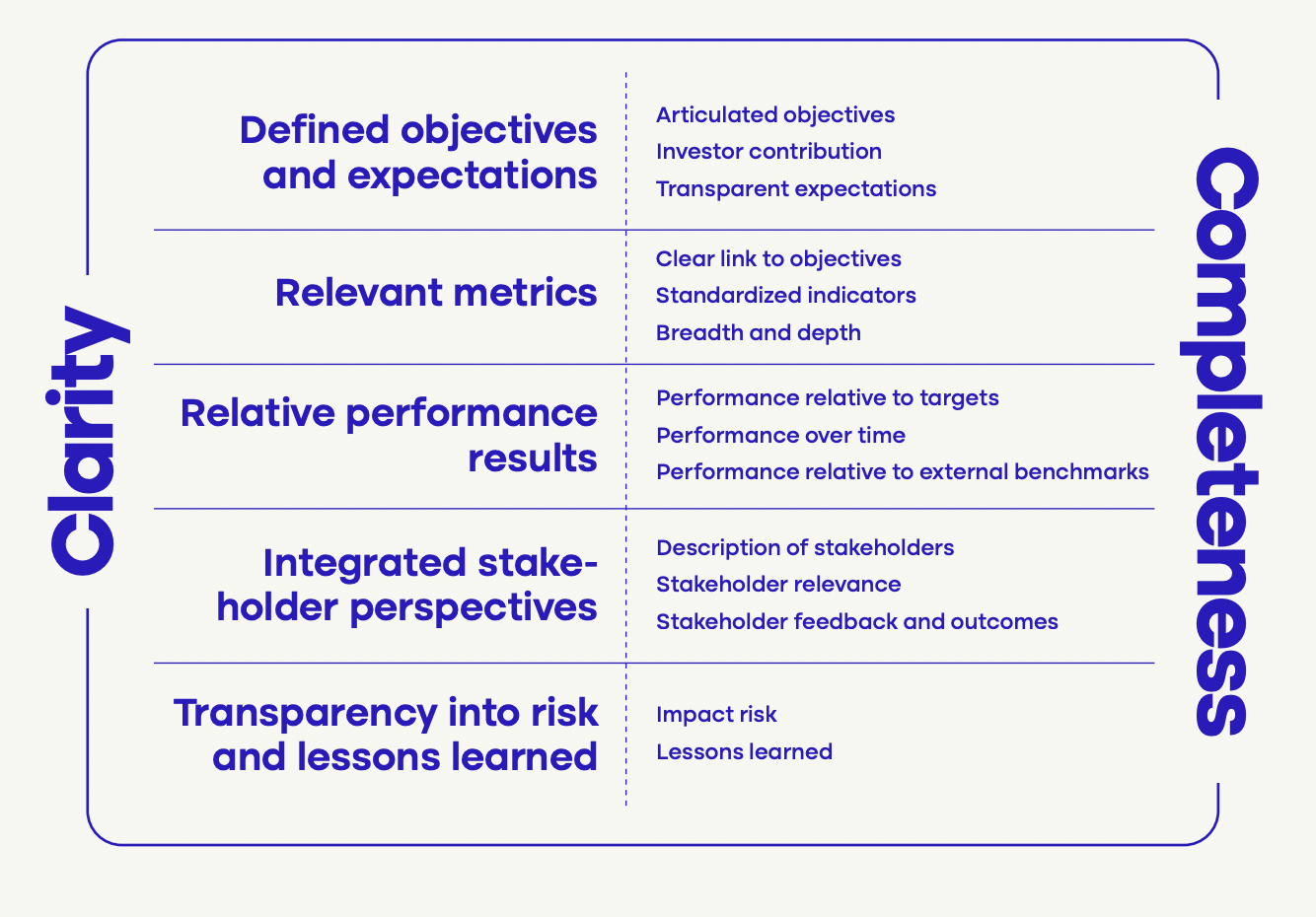
Based on our findings, the five key elements of quality impact reports, detailed below, support two overarching aims for all reports: completeness and clarity.
-
Completeness means that investors should provide information about all portfolio holdings and address impact performance at both the fund and holding level.
-
Clarity means that impact information should be presented in a way that is accessible and interpretable, with clear definitions, assumptions, and calculations.
We call on all investors for impact to commit to greater transparency, including each of the following five elements in their impact reporting:
-
Defined objectives and expectations: Be explicit about the fund’s intent and impact objectives, including clarity on investor contribution and expected results.
-
Relevant metrics: Include quantitative metrics that are drawn from industry standards wherever possible and that link to the articulated impact objectives.
-
Relative performance results: Provide information that allows the reader to effectively interpret and compare measures of progress and performance.
-
Integrated stakeholder perspectives: Identify affected stakeholders and incorporates their experiences and voices.
-
Transparency into risks and lessons learned: Be forthcoming about potential impact risks and past lessons learned.
For investors who are serious about impact, now is the time to take bold steps toward transparency, raising the bar for themselves and the industry. Share more than what feels comfortable; the work of investors for impact is more than marketing metrics and case studies and should be presented as such.
For more information, please see Raising the Bar, a research paper on the challenges and opportunities related to producing and consuming impact reports, made possible by grant funding from the Rockefeller Foundation and the Tipping Point Fund. Part Two will be released in late 2022.
*
ESADE Business School – Dr. Leonora Buckland, Dr. Lisa Hehenberger
Dr. Leonora Buckland is Senior Researcher at the ESADE Business & Law School. She is Principal Consultant at Stone Soup Consulting and Senior Consultant at Investing for Good. Previously, she was Executive Director of The Venture Partnership Foundation based in London, UK and a consultant for Ship2B, the Skoll Foundation, London Business School, EVPA and Giving Evidence. Dr. Lisa Hehenberger is an Associate Professor in the Department of Strategy and General Management at ESADE Business School and Director of its Center for Social Impact. She is a renowned expert on social entrepreneurship, venture philanthropy, impact investment, and impact measurement. She is the Chief Impact Advisor of Oryx Impact, a fund of funds investing in African impact funds, a member of the Board of Directors of the GSMA Foundation, and sits on the impact committees of Rubio Impact Ventures and Suma Capital. She is on the Scientific Board of the OECD Global Action "Promoting Social and Solidarity Economy Ecosystems", is a member of CNBC's Disruptor 50 Advisory Council, a group of leading thinkers in the field of innovation and entrepreneurship, and is a member of the Impact & Sustainable Finance Faculty Consortium set up by the Kellogg School of Management at Northwestern. She sits on the advisory boards of impact investing fund Creas, as well as Seastainable Ventures and Lyfebulb.
What would transparency look like within the context of IMM?
Impact transparency is critical to the future of the entire impact investing industry, especially as the industry receives more and more mainstream attention. Stakeholders consider impact washing a key risk and have identified the need to differentiate their activities from ESG and mainstream investing, often using impact management tools to clarify the distinction. Within the grant-making world, which other investors for impact inhabit, transparency is increasingly important as public scrutiny intensifies. The opaque, “mysterious” habits of the foundation sector are being challenged from within, as foundation employees embrace the new transparency zeitgeist. Transparency is a chance for investors for impact to illustrate their difference from mainstream actors (public or private) and a key component of being a learning organisation.
So, what would transparency look like within the context of impact measurement and management (IMM)? Our BBK-ESADE Community of Practice, which brings 47 foundations across Europe to discuss IMM topics, has produced a report that investigates this question in detail. Transparency examples include publishing, in an open-source way, impact data and impact evaluations; clarifying how grant and investing allocation decisions are made and what they were; publishing data on how voices of communities and beneficiaries are included and heard, as well as the organisation’s track record on diversity and inclusion; and publishing grantee/ investee feedback surveys. It would also mean signing up to standards and principles which have external validation, for example the UN SDG Impact Standards, one of which is ‘Transparency,’ or the Operating Principles for Impact Management for Impact Investors.
Yet of course, there are roadblocks to all this. Within the impact sector, we know that transparency is necessary, indeed essential, but some actors still may believe that transparency can hurt them at an organisational level. Most standards still only require transparency around the IMM process, not on actual impact data. There are few incentives for investors for impact and their investees to be transparent about impact achieved (let alone impact not achieved or negative impact). Although members of the BBK-ESADE Community of Practice foundations are very intentional about sharing their impact data, in general grant-making foundations share little publicly about what impact they have generated. Many external impact evaluations in the social economy are not published because the findings may not look so good for actors involved. Foundation boards, particularly where they are tied to corporate brands or families wanting to maintain privacy, often fear the consequences of opening up. Social economy actors are worried that if they are less than perfect, they won’t get future funding.
Thus, the social economy and impact investing still revolves around glossy impact reports and a sweeping under the table of what doesn’t work. If this continues, we will miss opportunities to share knowledge and will waste time reinventing the wheel. How can we get out of this transparency trap?
A shared movement towards transparency (such as Glass Pockets in the USA) and shared standards are hopeful pathways. New ratings systems, including the criteria of transparency exemplified by the Foundation Rating Practice in the UK, are already nudging investors for impact forwards. If we compare current levels of transparency to what they were a decade ago, investors for impact have come a long way. During the next decade, we should accelerate and deepen this trend.
*
BBVA -- Antoni Ballabriga & Lidia del Pozo
BBVA is a global financial group headquartered in Spain with a diversified business portfolio providing financial services in 25 countries, with over 119.000 employees and more than 80 million customers. Antoni Ballabriga is Global Head of Responsible Business at BBVA. He also holds the positions of Co-chair of the Global Steering Committee at United Nations Environmental Program for Financial Institutions; Member of the Steering Group at the Net Zero Banking Alliance; Chair of the Sustainable Finance Expert Group at the European Banking Federation; Member of the EU Commission High-Level Expert Group on Scaling up Sustainable Finance in Low and Middle Income Countries; and Member of the Board at the Spanish Green Growth Group. Lidia del Pozo is Director of Community Investment Programs at BBVA, where she is currently responsible for the Global Community Investment Plan, a commitment to invest €550 million and reach 100 million people between 2021 and 2025.
What are latest developments to foster transparency in the banking sector?
One of the main elements that characterises the participation of banks in sustainable finance is their ability to be fully transparent when disclosing information on sustainability to their stakeholders.
Transparency & Accountability is also one of the six UN Principles for Responsible Banking, signed by over 270 banks representing more than 45% of banking assets worldwide. These principles, a ”unique framework for ensuring that signatory banks make a positive contribution to people and the planet that society expects”, call for a commitment to be transparent about and accountable for the positive and negative impacts that banks make and their contribution to the goals of society.
This commitment is very relevant as the signatories vowed to report 18 months after signing the Principles, and annually thereafter, on their implementation. Since 2020 most signatory banks include this reporting exercise in their annual reports, including all relevant information on their sustainable practices, products and services and the impacts that they make.
Beyond regulatory requirements or collectively assumed commitments, banks also individually and voluntarily satisfy the demands of their investors and clients. Some good practices include:
-
Assuming individual commitments on sustainability goals and reporting on progress
-
Approving and disclosing internal regulation, such as sustainability policies
-
Reporting on the risks and opportunities of climate change in accordance with widely recognized standards, such as the one created by the Task Force on Climate-Related Financial Disclosures (TCFD).
-
Participating in sustainability ratings that measure ESG performance, demonstrating continuous progress in sustainability and guaranteeing their permanence in sustainability indexes
-
Making data available to all stakeholders, including clients, employees, suppliers and society in an easy-to-understand manner
Being transparent regarding sustainability is not easy. It needs science, facts and data and, at the same time, simple and educational communication. It requires courage to communicate not only positive but also net and negative impacts. Companies need to be engaging and make stakeholders aware that they can be part of the change.
BBVA has committed to consistent, reliable and standardised reporting of key ESG issues related to its business. Among several existing standards, BBVA discloses its non-financial information in the Statement of Non-Financial Information in accordance with guidance from the Global Reporting Initiative (GRI).
In addition, on a voluntary basis, BBVA publishes its progress via ESG disclosures according to widely recognised metrics such as the World Economic Forum’s International Business Council (WEF-IBC) metrics and those of the Sustainability Accounting Standards Board (SASB), which sets standards to guide companies on disclosure of relevant and consistent financial information relating to sustainability. Specific indicators under the SASB include Consumer Finance and Mortgage Finance standards. Beyond this, BBVA supports TCFD recommendations and has already released three TCFD reports.
***
This post first appeared as a LinkedIn article.