

Reliving Impact Days
Europe does not lack capital; it lacks the structures to deploy it where it matters most. While over €2.5 trillion is currently tied up in sustainable solutions across the continent, a striking 97% of private capital capable of driving real systemic change still sits completely on the sidelines. Closing this gap requires moving past abstract policy debates and into the mechanics of blended finance, risk-sharing, and cross-sector deployment.
This critical pivot from theory to execution took center stage at the recent Impact Days in Brussels, where over 200 global asset owners, foundations, financial intermediaries, and EU officials convened to build practical social-finance infrastructure.
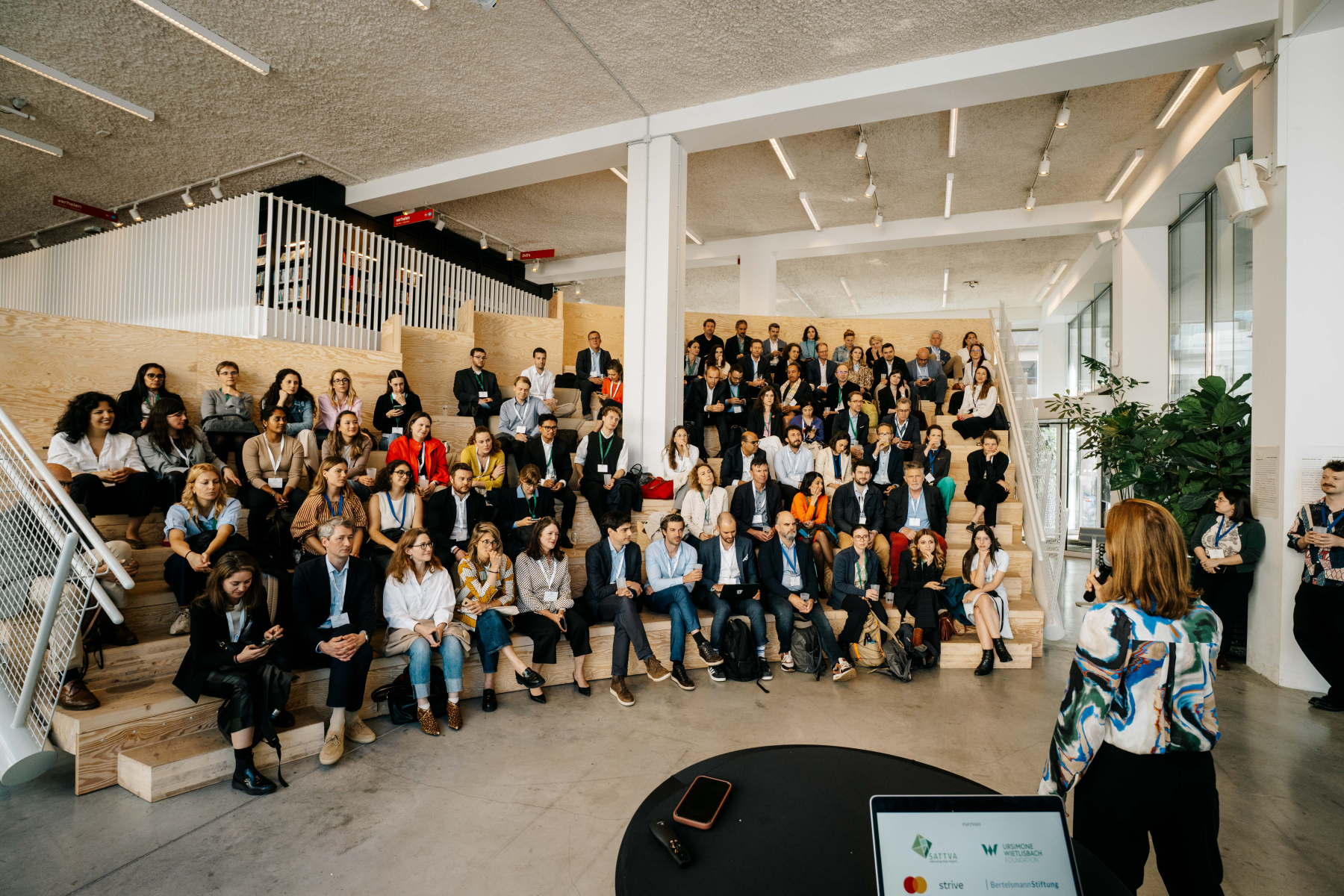
Stefan Germann flew home to Switzerland with a sense of urgency in mind. After two days at Impact Days, the CEO of the Ursimone Wietlisbach Foundation noticed the question in the room had moved. "What I hear more often now is not 'should we?' but 'how do we begin?'" he wrote afterwards. That shift from principle to practice is exactly what Impact Days set out to accomplish.
The theme of this years’ Impact Days was impact capital for systems change. Over 200 participants from 32 countries and four continents, a quarter of them capital providers, convened in Brussel. EU officials, foundations, banks, pension funds, fund managers and development banks, in one place, for once.
Day One: The Working Day
The first day, at the Muntpunt in the city centre, was for rolling up sleeves. It opened with Peer Labs on Impact Measurement and Management. In parallel, a 30-member working group spent the afternoon stress-testing "Shaping Capital Markets for Impact in Europe," a position paper built over five months of argument and discussions with major stakeholders. The diagnosis underneath it is blunt. Europe does not lack capital. It lacks the structures and incentives to move that capital at the right scale and duration.
Three EU side events gave the day its policy spine. With the philanthropy networks WINGS and Philea, members met the Commission's DG INTPA to map where foundations and impact investors can plug into Global Gateway and Team Europe Initiatives, and to seed a "Group of Willing" for those ready to co-invest alongside the EU abroad. A second session, with DG EAC, asked what catalytic European finance for the cultural and creative sector could look like. A third, led by Impact Europe's Filipa Lança de Morais, presented EcoVolve, an EU-funded project with Erste Social Finance, IFUA Nonprofit Partner and SIMPACT to build social-finance infrastructure across Central and Eastern Europe.
A separate workshop took on Europe's workforce paradox: employers short of talent while millions of young people stay locked out of work. In parallel, examples of collaboration in practice were shared by a variety of actors. The day closed with a reception, an Impact Run, and a private CEO dinner on endowment investing, ran by our partners at Ursimone Wietlisbach Foundation.
Day Two: The Plenary Day
On the second day, Impact Europe CEO Angela Wiebeck opened with a number the sector should find uncomfortable. Of all the capital in Europe that could sit in impact strategies, 97% does not. Impact Europe's CEO set it beside about €2.5 trillion already invested in sustainable solutions across Europe, more than the annual output of the Italian economy (Impact Europe, 2026), and three policy windows open at once: the Clean Industrial Deal, the EU Competitiveness Fund and the Savings and Investments Union. The capital exists. The coordination does not, or at least, not sufficiently yet.
Markus Freiburg, founder of FASE and Impact Europe’s new chair, gave it an edge. Europe keeps copying a US venture model built on tech bets and quick exits, he argued, and that leaves whole categories of useful companies unfunded. A video message from Mario Nava, Director-General at DG EMPL, added the Commission's backing. Then the room split along three tracks: public money, private money, and scaling innovation.

On scaling, the diagnosis was stark. A 2026 survey of 142 climate-tech founders found 91% struggling to raise growth capital. Europe starts as many companies as the United States and ends with far fewer at scale; US late-stage venture deployed roughly $230 billion last year against Europe's €50 billion, as Bita Sehat of Trill Impact noted. Espen Daae of Ferd refused to treat venture as the answer at all, asking whether the community should "mobilize into an asset class or to solve problems." Venture, he said, is good at "farming winners" and "horrible at solving wicked problems."
On public money, the case was made for it to act as multiplier, not a one-off grant. Bruno Robino of the European Investment Bank described the advisory machinery behind EU instruments, fi-compass and SIFTA, which has reached more than 100 financial intermediaries in three years. Peter Surek of Erste Social Finance, which has mobilised around €850 million of loans across Central and Eastern Europe, described building a market "from scratch" and warned that public banks lending at zero rates can quietly kill the private one.
On private money, the panels went after the 97% directly, and the strongest material was in the deals. Axel de Ville of ADA showed how a $600.000 junior note in Rwanda mobilised $26 million. Sylvia Giezeman of Cardano described a sanitation-lending pilot in India that hit 97% loan utilisation. Irene Di Ciommo of the EBRD walked the room through a $523 million, first-of-its-kind solar and battery project in Egypt, and a Mongolian facility where €40 million from the bank opened the door to €100 million from institutional investors including Allianz. This is what "unlock the capital" looks like when it works.
Markus Freiburg closed with a commitment rather than a summary. Impact Europe will open talks on a €1 billion blended facility with the Children's Investment Fund Foundation, public first-loss money sitting under private. Seb Elsworth of Access and Paul Ronalds of Save the Children Global Ventures took the final couch, on dormant assets and child-lens investing. Wiebeck's parting instruction was to leave the impact bubble and go find the mainstream investors holding the other 97%.
What People Took From It
The testimonials told the same story from different seats. Jérémie Meyer of Esade described a room "all wrestling with the same question: how do we move more private capital toward the things that actually matter?" Kyra Constanze Pauly of the Bayer Foundation singled out the Global Gateway dialogue with the Commission and philanthropy, with the caveat that the work now is "translating them into tangible action and measurable outcomes." Adriano Scarampi of LuxFlag, who attends a lot of conferences, said this one "stands out from the crowd." From our side, we believe it is the crowd at Impact Days that stood out.
Next stops are already set: the Impact Fund Model 2.0 paper, which will be shared at the end of June publicly, and the Business of Impact in Lisbon in September.