Resonance’s homelessness property-fund model
Turning £10 million into a £ 360 million system

Download the case study
Executive summary
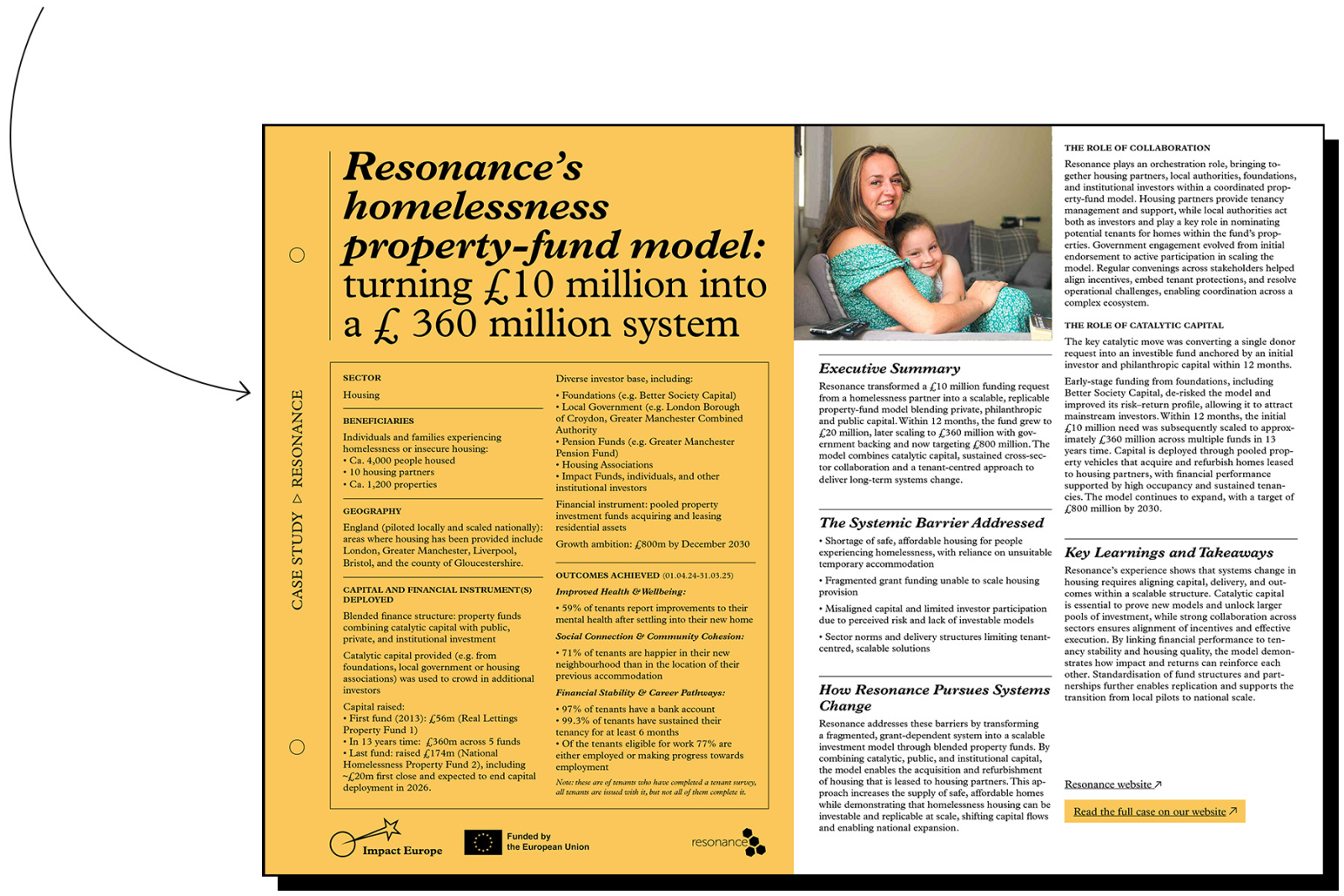
Resonance transformed a £10 million funding request from a homelessness partner into a scalable, replicable property-fund model blending private, philanthropic and public capital. Within 12 months, the fund grew to £20 million, later scaling to £360 million with government backing and now targeting £800 million. The model combines catalytic capital, sustained cross-sector collaboration and a tenant-centred approach to deliver long-term systems change.
1. What structural or systemic barriers does the initiative tackle?
A UK homelessness partner sought £10 million to provide safe, settled housing for individuals and families in Temporary Accommodation. However, fragmented and insufficient grant funding could not meet demand. Misaligned capital, weak investor incentives and unequal tenant norms limited the ability to scale housing provision sustainably without a new financing model.
2. Systems change: addressing root causes (not symptoms)
Instead of a project-based grant response, Resonance created a blended property fund pooling public, private and institutional capital into an investible vehicle. Catalytic philanthropic capital de-risked the model, addressing the core mismatch between social need and available capital and enabling repeatable, long-term investment flows.
3. Systems change: which leverage points have been activated and how?
Resonance activated multiple leverage points across the system: it shifted mindsets by reframing philanthropic, public and private capital as complementary routes to social outcomes. It aligned incentives through fund terms and contractual protections linking investor returns to housing partner goals and tenant wellbeing. Regular cross-sector convenings strengthened relationships and sped up delivery, while influencing also public policy as government backing helped scale the model from proof of concept to national reach. Together, these levers reset incentives, normalised investor participation and strengthened tenant protections.
4. Key facts in a nutshell
| Sector | Housing |
| Beneficiaries | Individuals and families experiencing homelessness or insecure housing (as at 31 March 2026):
|
| Geography | England (piloted locally and scaled nationally): areas where housing has been provided include London, Greater Manchester, Liverpool, Bristol, and the county of Gloucestershire. |
| Capital and financial instrument(s) deployed and outputs |
|
| Outcomes achieved | 1st April 2024- 31st march 2025:
Note: these are of tenants who have completed a tenant survey, all tenants are issued with a survey, however not all of them complete it. |
5. From Silos to Synergies: The Role of Collaboration in achieving Systems Change
Actors involved: Resonance (Fund Manager, intermediary); the homelessness partner (originating sponsor and operator); initial investors who were foundations and other socially motivated backers; government (endorsement, investor and scaling partner); property operators/housing associations (management partners).
Engagement: Regular multi-stakeholder meetings resolved deal friction, aligned incentives and codified tenant protections. Government engagement evolved from endorsement to scaling partner once investability was proven.
Barriers encountered: Tight timeline for the 12-month raise; coordination across diverse stakeholders; entrenched sector norms disadvantaging tenants; and the need for credible public endorsement to scale.
Favourable conditions: A lead investor willing to commit and be challenged to scale; receptive foundations; Resonance’s structuring expertise; a government prepared to endorse and scale the model; and sustained monthly collaboration that built trust and solved operational problems quickly.
A focus on engaging with the public sector:
The funds maintain strong relationships with local authorities. Many of the fund’s investors are local authorities, and our housing partners also work closely with them. Local authorities provide temporary accommodation for individuals and families and play a key role in nominating potential tenants for homes within the fund’s properties.
In addition, Resonance contributes to central government housing strategy and actively advocates for changes in public policy. This includes campaigning for initiatives such as a national strategy to support the reuse of empty homes across the UK.
6. The role of catalytic capital in achieving systems change
The key catalytic move was converting a single donor request into an investible fund anchored by an initial investor and philanthropic capital within 12 months. This de-risking capital improved risk–return profiles for mainstream investors and enabled replication.
The diagram illustrates how the initial 2013 fund scaled to five funds over 13 years:

Financial structure & sequencing in detail:
1.Structure: A blended property fund: catalytic capital combined with public/private/institutional capital in an investible vehicle.
1st fund: This fund was called Real Lettings Property Fund 1, it was launched in 2013 and raised and deployed £56m of capital. This capital came from Foundations (including Better Society Capital), Housing Associations, Impact Funds and Local Government (including London Borough of Croydon). The largest investments came from London Borough of Croydon). The first investors, into the first close of the fund were Foundations who provided catalytic capital to encourage others to invest. The fund bought c260 refurbished properties across London, and then leased them to one housing partner, homelessness charity St. Mungos.
After 13 years time, Resonance now has 5 Homelessness Property Funds, in total, with almost 1,200 properties in major cities across England. The funds have housed c4,000 people over time, securing c£360m in investment from Foundations (including Better Society Capital), Local Government (including Greater Manchester Combined Authority), Pension Funds (including Greater Manchester Pension Fund), individuals and other institutions.
The last fund launched was called National Homelessness Property Fund 2 (NHPF2), which raised £174m of capital, and will finish deploying this capital in 2026, purchasing properties across England in places such as Greater Manchester, Liverpool, Bristol, Gloucestershire and London. This capital will purchase and refurbish c300 safe, settled and affordable homes for individuals and families who are in Temporary Accommodation. The initial investors into NHPF2 in the first close were a combination of a Foundation (Better Society Capital), Local Government (Greater Manchester Combined Authority) and a Pension Fund (Greater Manchester Pension Fund), this first close raised c£20m in capital. The funds now work with 10 Housing Partners who lease properties from the funds and provide tenant management and support.
2.Orchestrator: The funds led and created by Resonance in collaboration with the homelessness partner and investors; rapid, joint fundraising design enabled the 12-month £20million raise.
3.Catalytic capital: The initial £10 million and foundation capital acted as catalytic/de-risking capital that made the vehicle attractive to mainstream investors by improving risk/return profiles.
4. Performance conditions: Fund governance embedded tenant protections and reporting that tied investments to social outcomes.
While there is no direct, contractual link between impact outcomes and financial performance, the relationship between the two is nonetheless significant.
First, investor returns are driven by capital appreciation of the property portfolio and rental income. The portfolio maintains a consistently high occupancy rate, resulting in low void levels. This strong occupancy reflects the effective use of assets to house individuals and families who would otherwise remain in unsuitable temporary accommodation. Conversely, higher vacancy rates would negatively affect both financial returns and the delivery of social outcomes.
Second, the investment strategy prioritises acquiring properties in central, well-connected communities and refurbishing them to a high standard. This approach supports the preservation of asset value. Simultaneously tenants benefit from centrally located properties which makes it easier for them to access key service and find employment, training opportunities, and they also benefit from properties that are well refurbished and energy efficient.
5.Resources required: Legal structuring, transaction advisory, investor outreach, time and convening capacity to run monthly coordination and close the raise rapidly.
7. How to ensure impact drives systems change: the role of outcomes and theory of change
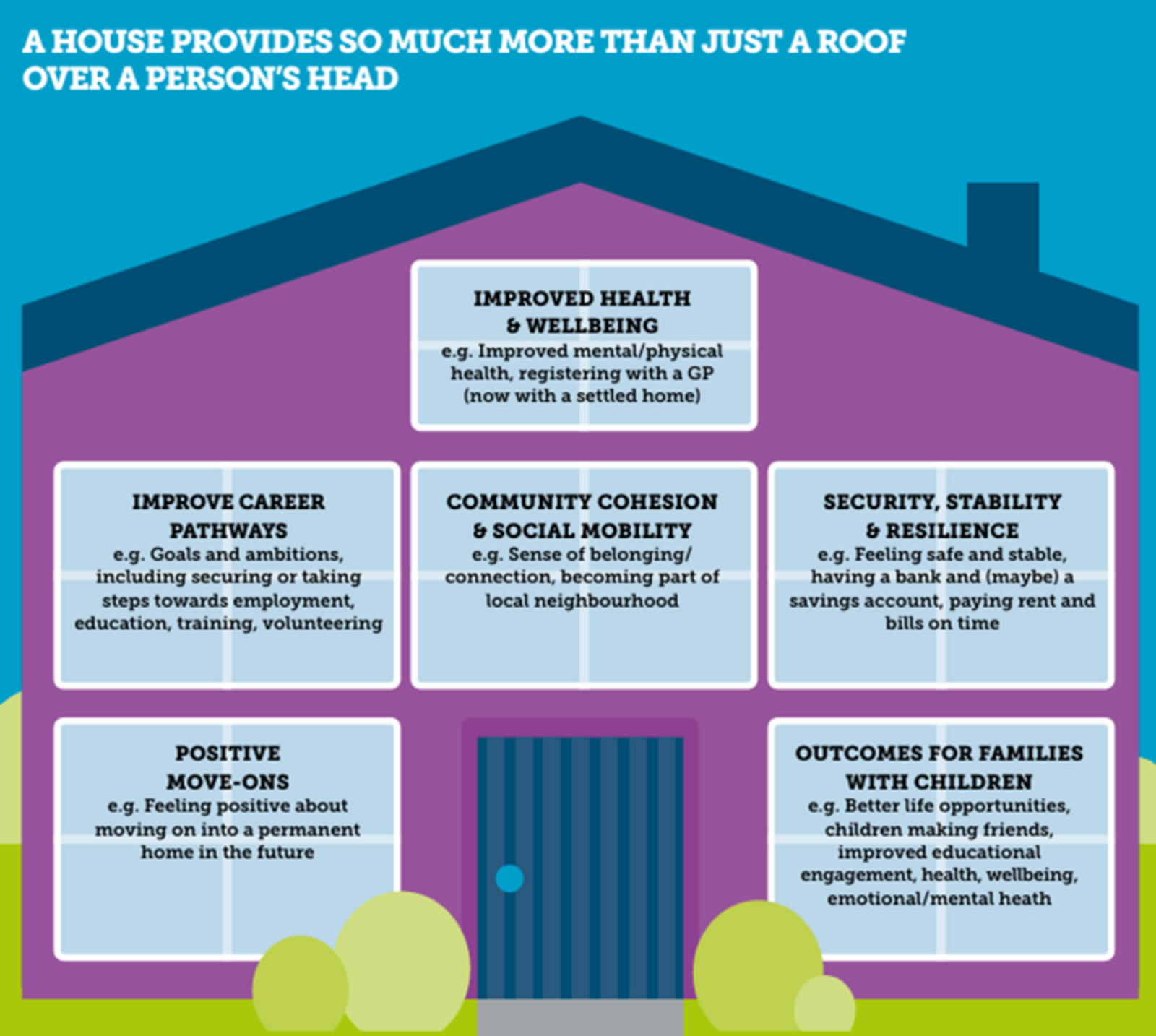
Resonance’s Theory of Change (Source: page 8 of 2025 report) is grounded in the premise that providing safe, affordable, and well-located housing, delivered in partnership with housing organisations, enables individuals to move from crisis to stability and improve their long-term life outcomes. The results achieved to date strongly reflect this causal pathway. By increasing the supply of affordable homes for people experiencing homelessness, sustaining tenancies, and mobilising private capital at scale, Resonance has housed around 4,000 individuals and families across 1,200 properties in collaboration with 10 housing partners. Its outcomes framework further evidences how stable housing translates into improved wellbeing, stronger social connections, and greater financial stability. Resonance measures long-term impact through a structured outcomes framework. Each year it conducts a tenant’s survey to understand how secure, affordable housing affects social, economic and wellbeing outcomes, tracked between April 1st 2024 and March 31st 2025, highlighting three key outcome areas:
1st April 2024 - 31st march 2025:
- Improved Health & Wellbeing: 59% of tenants report improvements to their mental health after settling into their new home
- Social Connection & Community Cohesion: 71% of tenants are happier in their new neighbourhood than in the location of their previous accommodation
- Financial Stability & Career Pathways
• 97% of tenants have a bank account
• 99.3% of tenants have sustained their tenancy for at least 6 months
• Of the tenants eligible for work 77% are either employed or making progress towards employment
Note: these are of tenants who have completed a tenant survey, all tenants are issued with a survey, however not all of them complete it.
8. Learnings if starting a new systems change collaboration tomorrow
- Formalise first-loss or guarantee mechanisms
- Importance of aligned Housing Partners and standard tenancy clauses early to speed investor onboarding and replication
- Produce a legal/operational playbook and standard Monitoring & Evaluation templates
- Ringfence dedicated fundraising capacity to meet the urgent need for safe, settled, affordable accommodation.
9. Key takeaways
Resonance’s model demonstrates how catalytic capital can unlock large-scale, systemic change by aligning public, private, and philanthropic funding into a blended property fund. By reframing incentives and fostering cross-sector collaboration, it transformed fragmented housing support into a scalable investment model, growing from £10m to £360m. The approach not only increased housing supply but also embedded tenant wellbeing and long-term outcomes at the core, proving that investable structures can sustainably address homelessness at scale.
Do you have a relevant case of collaboration that has successfully achieved systems change and you would like to share? Please complete this form: we are collecting essential information and will follow up with you if your case aligns with our library.
We are gathering cases only from Impact Europe members, if you're not a member yet and would like to know more, get to know us!
Quote:
“The best thing about our new home is that
it now feels like a home. We are all happy. The children are
more settled too. Both are involved in Cubs and Rainbows, giving
them opportunities to interact with others outside school.
Seeing my children go from a cold flat where they were always
being told to keep the noise down, to now being able to run outside
when they want and not having blankets wrapped around them all
the time - it has made a massive change in them. And there are no
stairs for my son to fall or jump from, and having the shop close by
makes things easier after school or a day out.
I grew up in a happy, stable home with food and warmth and a roof
over our heads. That’s all I want for my children.”
ADELE, TENANT
Sources:
- Contributors: we would like to express our sincere gratitude to Resonance’s team, especially to Daniel Brewer and Paul Handford for generously sharing their time and insights through interviews and exchanges.
- Resonance_Annual_Report_2025.pdf
- Social Impact Report 2024-25
- Resonance plans homelessness property funds’ expansion | Impact Investor